Your future baby's portrait: how it is drawn and read
Published on
You answer a few questions about yourself, about the other parent and about the family you dream of. You add a photo, and a pencil portrait of your future child is drawn, with a reading written for you. Here is what happens at each step, including what this portrait does not do.
What you get at the end
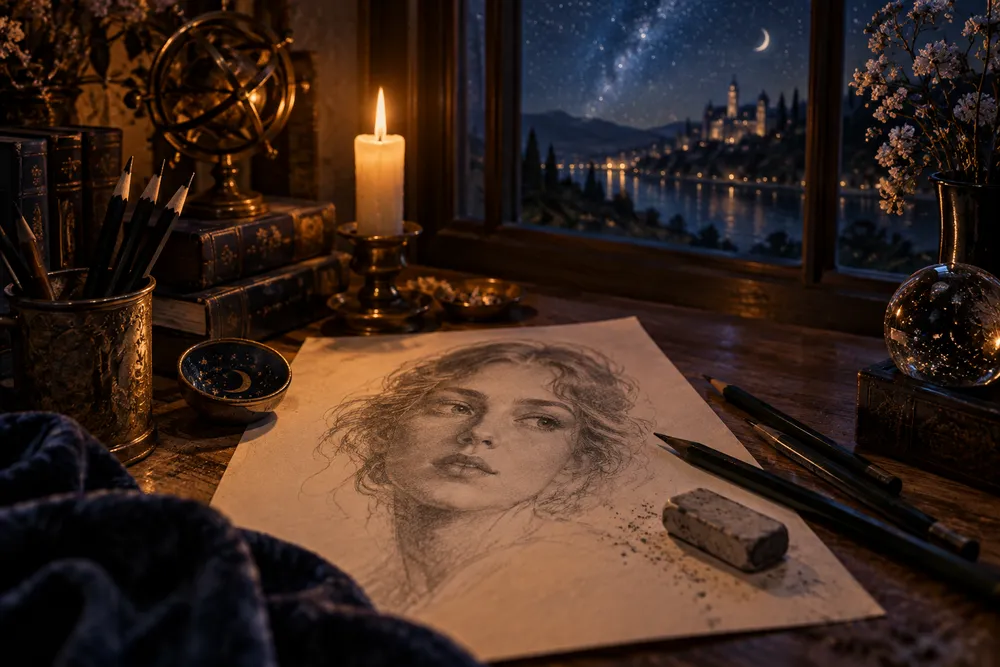
Two things go together: a portrait and a reading. The portrait shows a baby of about one year old, head and shoulders, in a gray pencil sketch on white paper. The line stays a little unfinished, with plenty of bare white paper. It is a drawing, not a photo.
The portrait and the reading wait for you in your personal space, and a link sent by email lets you come back whenever you like. Allow about three minutes to answer the questions.
First, a few questions about you
You give your first name, say whether you are a woman, a man, or prefer not to say, then enter your date of birth. It gives your sun sign, which the reading uses to speak about your future child. There is no right or wrong answer.
Then come six questions about you. Where are you in your love life? When do you hope to welcome a baby: within the year, in two or three years, one day, later, or is it already on its way? Or do you already have children and want more? What does your heart say, a girl or a boy, or would you rather let the universe decide? Then your origins, the color of your eyes and the color of your hair.
The other parent, even if they are not there yet
Three questions cover the same topics for the other parent: their origins, their eyes, their hair. Each one offers an answer for those who have not met them yet or who do not know. In that case, the portrait starts mostly from you.
Another question matters a lot for the drawing: do you imagine a child who looks like you, or one who brings you contrast and surprises? If you choose resemblance, their eyes and hair are yours. If you choose contrast and you gave the other parent's eyes or hair, they come from them. When your origins differ, the portrait blends them. If you are thinking of someone in particular, the article on romantic compatibility presents another reading for two.
The family you dream of
Five questions are about the child you imagine and about you as a parent. What personality do you wish for them: gentleness, curiosity, creativity, joy, confidence, or something unique? What are you most looking forward to? What worries you most? Which way of raising a child feels like you? Do you already feel a bond with them? “Not really” is one of the possible answers.
These answers do not draw the face. They feed the reading: each section is written knowing what you answered.
The photos of the faces
You are asked for a photo of your face, and it is the only required photo. The other parent's is optional. If you do not have one, you can pick a face from a gallery of fifteen faces created by AI: dads if you are a woman or prefer not to say, moms if you are a man. The ones closest to what you answered about the other parent appear first. The chosen face then replaces your answers about the other parent's origins, eyes and hair, so the drawing does not receive two contradictory instructions.
Your photos stay private and are used only to make your baby's images. Once the portrait is drawn, the uploaded photos are deleted, except yours, kept aside for the images where you appear with your baby. The drawing takes the likeness from it: the shape of the face, the eyes, the nose, the mouth, the hair. It never draws the adults, and it never copies a photo. If the image model refuses a photo, the portrait is drawn from your answers alone.
How the portrait is drawn
The portrait is drawn by an artificial intelligence model, with a precise instruction: a graphite pencil sketch, visible strokes, light hatching for the shadows, plenty of white paper, no color, no text. Its features come from your answers and your photos: blended origins, eye color, hair color. The baby's sex follows your intuition. If you let the universe decide, a fixed draw decides it, always the same for you.
The portrait is drawn once. While you wait, three steps go by: the blending of your features, the first pencil strokes, the last details. With the same answers and the same photos, you get the same portrait back. The page says it itself: it does not show exact features, but the energy and tenderness of your bond. The principle is close to that of the article on the soulmate portrait, also drawn from what you describe.
The reading, section by section
The reading has eight sections. The welcome speaks of what your sign says about the soul joining your family. Then come the names, with five suggestions and a sentence to say why each one fits, and a few letters that will come back in their life. Next, the arrival, the personality, the talents, your bond as parent and child, the guide to their first years, and finally the conclusion.
Each section is written when you open it, for you, speaking to you directly, from your sign, your answers and the baby's sex. It runs between 220 and 330 words, except the welcome, which is shorter, between 120 and 180. The text is written by an artificial intelligence, with the instruction to stay tender and imaginative. The section on the bond speaks of how the child will give and receive love, and of the words that will help them feel understood.
What the portrait does not do
This portrait says nothing about your health or about what is possible for your body. The instruction given to the reading is clear: stay tender and imaginative, with no promise about health or about the possibility of having a child. Even the section on the arrival speaks of the most favorable seasons in the years ahead, of signs that might announce their coming, and of an imagined first moment. For these questions, turn to a health professional.
Nor is it the true image of your child. No drawing can know what they will look like. The portrait and the reading are symbolic, to be read for dreaming, for thinking about what you hope for, and for pleasure. They decide nothing for you.
To begin
Get a photo of your face ready, and answer simply: “I don't know yet” is a real answer for the other parent. Whenever you like, you can draw the portrait of your future baby and read what your reading says about them.
If you are hesitating between other readings, the article which reading to choose helps you find your way. Your portrait and your reading then wait for you in your space, where a link sent by email brings you back.
Also worth reading
How your soulmate portrait is drawn, answer after answer
From your answers to the pencil: what the questionnaire changes in your soulmate portrait, what is calculated, what is written, and what it is not.
Read the article
Your past life on Profondio: how it is chosen, step by step
The questions, the catalogue of 40 lives, the selfie and the story: how Profondio imagines your past life, and what this reading does not claim to do.
Read the article
Love compatibility: what we calculate, what we cannot tell you
Eight questions, two charts compared planet by planet, a percentage and a reading in four parts: this is how love compatibility is calculated.
Read the article